
We are pleased to share the publication of a new peer-reviewed study in the Journal of Antimicrobial Chemotherapy – Antimicrobial Resistance, that demonstrates the efficacy of our lead antibiotic candidate, Epidermicin NI01, as a potential treatment for drug resistant skin and wound infections.
The problem: antibiotic resistance in skin infections
Skin and wound infections are some of the most common reasons for antibiotic prescribing in the UK. These infections are often caused by bacteria called Staphylococci and Streptococci, and are commonly treated with antibiotic creams. More than 16% of all antibiotics are prescribed for this reason.
However, resistance to existing antibiotic treatments is rising. About half of the bacteria causing these infections are now resistant to at least one of the two most widely used antibiotic creams. This means that previously reliable treatments are becoming less effective, and increases the risk of infections spreading or becoming more serious. Amprologix is therefore developing Epidermicin NI01 as a novel treatment to address this problem.
What our study investigated
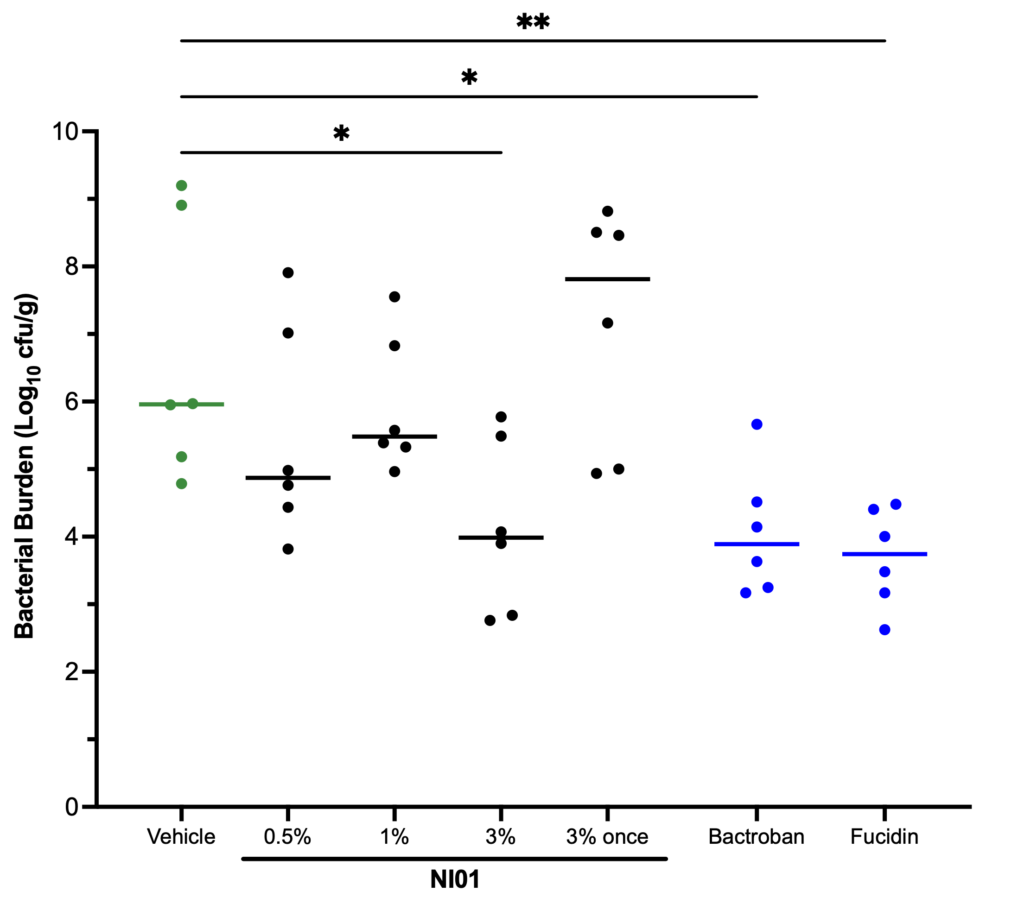
In this new study, we investigated whether a wound infected with MRSA could be treated with a cream containing Epidermicin NI01. Mice with MRSA-infected wounds were treated once daily for three days with a cream containing NI01. The number of bacteria in the wounds were counted after three days to determine whether NI01, or two comparator creams used in clinical practice, were able to reduce the number of bacteria in the wounds. These comparator creams were Bactroban (containing mupirocin), and Fucidin (containing fusidic acid). We also included a control group treated with a cream containing no antibiotics, known as a ‘vehicle control group’.
How to read this graph
Each dot shows the result for one animal, and indicates the number of bacteria (or ‘colony forming units’ per gram of tissue) that were present in the wound after three days of treatment. The horizontal bar shows the average for each group. Whilst treatment with creams containing 0.5% or 1% NI01 did not significantly reduce the number of bacteria, 3% NI01 did - to a similar level to that of Bactroban and Fucidin, indicating a similar level of efficacy. An additional treatment group received a single 3% dose of NI01 on the first day only. This single treatment also caused no reduction in bacterial numbers.
In addition to counting the number of bacteria at the end of the study, we also tested whether the bacteria exposed to NI01 had become more resistant than they were before treatment. Despite repeated doses of NI01 over a three day period, the MRSA bacteria did not become more resistant to NI01. This means that the drug did not become less effective over this time frame.
Key Findings
- Matched efficacy: 3% NI01 was as effective as Bactroban at reducing the number of bacteria in infected wounds
- Greater molar potency: NI01 achieved this result at a lower molar concentration of active ingredient that mupirocin (the active antibiotic component in Bactroban), suggesting a higher intrinsic potency
- No adverse effects: None of the animals treated with NI01 showed any signs of toxicity or side effects
- No resistance development: Bacteria tested at the start and end of the study showed no increase in resistance to NI01, an important findings given the rising challenge of resistance to existing treatments
Why these results are important
The ability of NI01 to match a current standard of care antibiotic cream without inducing resistance over this time frame is significant. One of the main concerns with current treatments is that bacteria can adapt to become more resistant over time, making the treatments less effective. Although so far NI01 has only been tested over a short time period, the lack of resistance development in this study signals the encouraging potential for NI01 as a treatment option.
These results have been published in the Journal of Antimicrobial Chemotherapy – Antimicrobial Resistance, providing an independent, peer-reviewed validation of NI01’s efficacy in this experimental model.
Next Steps
These results add to the growing body of evidence to support the continued development of Epidermicin NI01. Our aim is to bring a novel therapy to patients who are no longer able to reply on the treatments currently available, and this study is an important step towards that. You can read the complete peer-reviewed findings here.